
Another unique way that the location of the wing and tail on the fuselage impact our aircraft’s stability:
This starts to get us to think about stability impacts in more than just one dimension. I’ve worked with a handful of configurations now where I’ve noticed something odd: the combination of the tails’ distance behind the wing, as well as the height above or below the wing, plays a role in pitch stability.
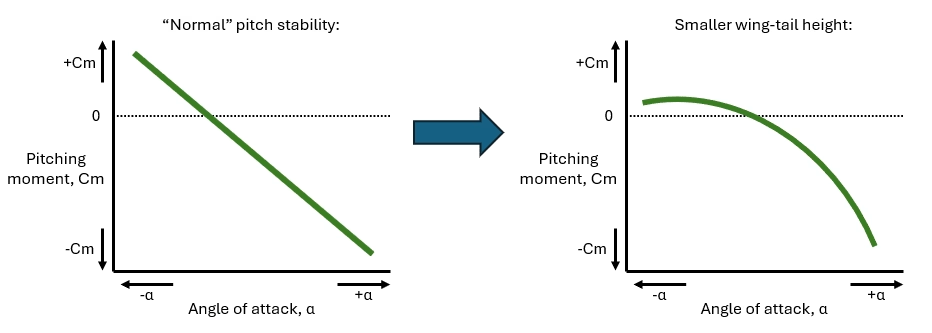
What I’ve seen in my analysis has been that having the horizontal tails closer to the wing in the Z axis (i.e. the “height axis”) makes the line of pitching moment coefficient versus angle of attack start to curve.
Typically you want your coefficient to be a decreasing diagonal line; this creates the negative, or nose-down, pitching moment at larger positive angles of attack.
Having the wing and tails at similar heights, though, starts to curve this line. At higher angles of attack the slope of the line gets steeper. Meanwhile, in the region of positive pitching moment, the slope of the line decreases until in some cases, at large negative angles of attack, it reverses slope!
Super weird, right?
The reverse is true: for these configurations, increasing the height of the tails above the wings straightens the line back out from this curve.
I’ll admit, this is only something I’m seeing in my primary design tool. I want to try to analyze these same configurations in some other design tools as well, and do some testing to see if there are relatively consistent geometry relations to predict this.
I have a strong feeling this has something to do with the downwash coming off of the wing interacting with the tail and making it so the tail “sees” a different angle of attack. Who knows if this will pan out to something meaningful—but it stood out to me as something I’d never seen before, so I wanted to share it. If I find time to test this out I’ll be sure to report back what I find!
Tomorrow, my last unique way that wing and tail location contribute to stability: swept wings.
Sidenote: Yes, I finally quit writing these so late at night and started making diagrams to illustrate what I’m talking about. I realized while trying to describe a diagonal line that I could just, y’know, draw it.
If I sent out a handful of diagrams to illustrate some of the concepts I’ve been talking about, would that help you better understand? Please let me know.