
And finally, the wing and tail locations influence stability in a way you’ve probably seen before: swept wings.
A wing is “swept” when, instead of the very front leading edge being ruler-straight across the entire wingspan, the leading edge is moved further back as you move out in span. This ends up with the leading edge of the wingtip being further back than the leading edge of the base, or root, of the wing.
You’ve seen this if you’ve ever seen a typical commercial aircraft, like a Boeing 737. Swept wings are usually used for different reasons, mainly reduced drag and better performance for higher speeds. But using a swept wing also impacts your pitch stability.
The reason? Like we’ve covered before, what influences stability is the lift of the wing and the lift of the tail. If you think of a regular straight-across, Hershey bar wing (yes that’s a technical term) all of your lift is being generated at the same location along the fuselage. We often estimate it as acting at a point that is one-fourth of the chord back from the leading edge, or the quarter-chord.
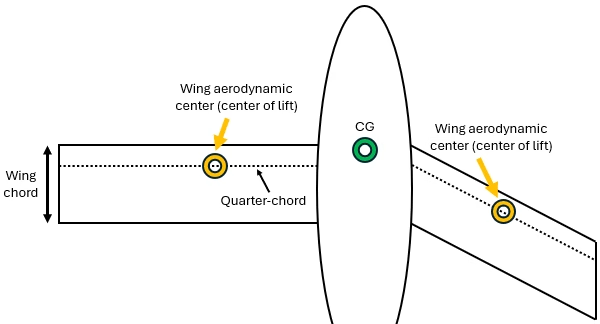
But on a swept wing, even if the wing is attached at the same point on the fuselage, because the wing moves backwards, the lift generated also moves backwards.
The total lift contribution of the wing ends up being further back relative to the CG. That means the neutral point—the center of lift, or aerodynamic center, of the full airplane—ends up further back too, without even needing to move things around!
The same physics applies to your tail, as well: you can sweep the tail back slightly and move its center of lift further back on the airplane.
This is a fun knob to twist when you have other limitations on your design that mean you can’t move your entire wing or tail around. It can get you the extra little bit of stability you need in a design—but it’s also something to watch out for if you’re sweeping the wing or tail for other reasons.
This has been a solid week or so of pure physics and nerdy technical terms. If you’re still reading, I appreciate you!
We’ve only just started to scratch the surface of aircraft stability, though. I’ll take a bit of a break for the next few days and send some less intensive content before we get technical again.
I would genuinely love to hear your thoughts:
- Has this been informative, or at least mildly interesting?
- Do you like learning about the physics of why airplanes look the way they do?
- Or would you rather see more general content that doesn’t get into the nitty-gritty as much?
Please let me know! You won’t hurt my feelings, I promise. It’s honestly really helpful to hear what you find valuable or interesting, and what might be better off as blog posts or other long-form content instead.