
It was my birthday a couple weeks ago, and this is my email list. So I’m going to have some fun and talk about dinosaurs.
More specifically, I think it’s worth exploring some potentially interesting parallels between the evolution of flight in the fossil record, and the explosion and variation of vertical take-off and landing (VTOL) UAV designs debuting today.
Our precedent in the animal kingdom
Let’s lay some groundwork. Continuous, self-propelled flight has only evolved within four groups in the entire animal kingdom: insects, pterosaurs, dinosaurs, and bats. Today I want to focus on pterosaurs and dinosaurs’ descendants, the birds. Insects fly in a very different way than the other three groups due to their size, and bats haven’t (yet) achieved large enough sizes to be relevant to this comparison.
A pterosaur is what you probably picture if I say “pterodactyl.” They’re extremely closely related to dinosaurs (about as closely related as crocodiles) but because they are primarily flying animals they are not dinosaurs. And they are hyper-specialized for flight: their arms look like ours, but they substantially stretched their littlest finger to be longer than all the other bones combined.
This elongated finger makes up the primary spar of their wing, suspending a lift-generating membrane of skin and muscle. We don’t know exactly where this membrane ended on the body, but it likely spanned from that little finger down to at least the hips, if not the back feet, and some species had additional membranes between the legs and tail. The end result is almost the entirety of a pterosaur’s body is lifting surface, like a base jumper’s wing suit.
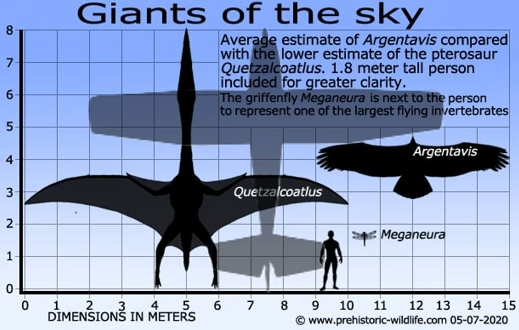
This matters because pterosaurs got big. Some of them became the largest flying animals in earth’s history. This honor goes to a group called the azhdarchids (ash-DARK-ids), appropriately named after a dragon-like creature in Persian mythology. One of the largest species, Quetzalcoatlus northropi, likely had a wingspan of 10-12 meters, or 33-39 feet.
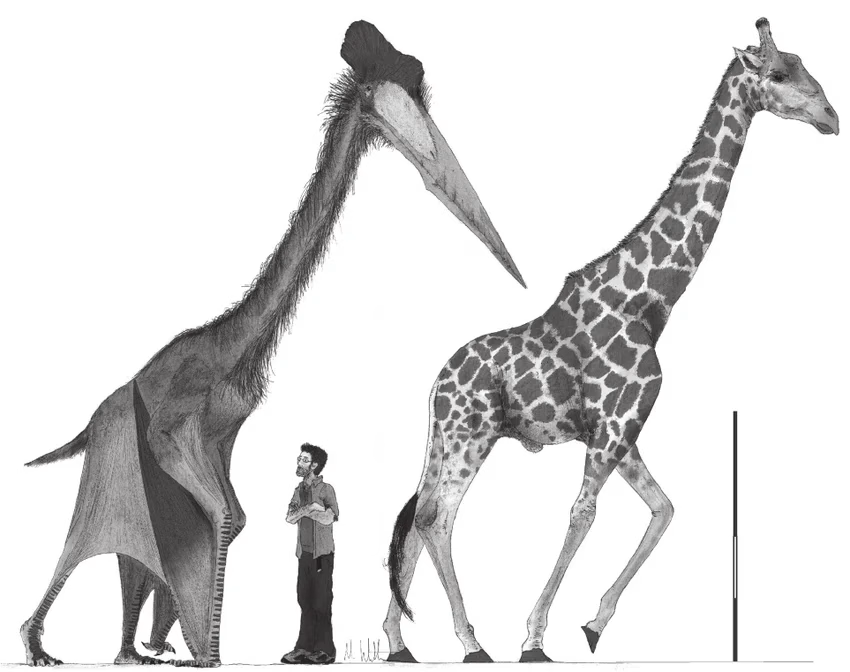
In comparison, one of today’s most common general aviation aircraft, the Cessna 172 Skyhawk, has a wingspan of 36 feet. These pterosaurs were the size of an airplane, weighed 300+ pounds each, and on the ground would have stood eye-level with a giraffe.
Contrast this with the largest known flying birds, a.k.a. heavily specialized dinosaurs. The previous record-holder was Argentavis, a relative of vultures that lived around six million years ago in what is now Argentina. Its wingspan has been estimated to have been about 18 ft, and it likely weighed somewhere around 150 lbs.
In 2014 a new species was discovered that had an even larger wingspan. This species of Pelagornis lived 25 million years ago in today’s South Carolina, and its wingspan further stretched to 20-24 ft. It’s not necessarily the largest flying bird ever though because it likely weighed significantly less, estimated to be under 80 lbs.
Multi-purpose propulsion – the biological version
We have two extremely successful groups of flying animals who reached incredible sizes. But one group was able to achieve wingspans and weights nearly twice that of the other group’s maximums. Why is that?
The answer likely comes down to evolutionary paths: pterosaurs appear to have optimized for flight extremely early on, to the point that we don’t even have any pterosaur relatives not already fully adapted for flight. They clearly quickly poured resources into building out the wing bones and muscles needed for efficient flight and left their hind legs just “good enough.”
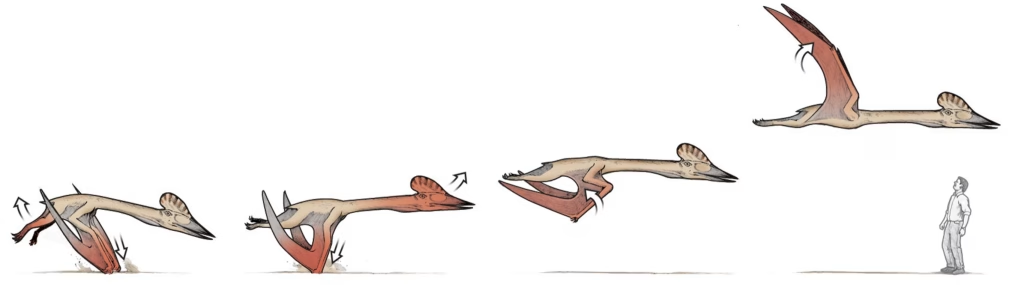
It’s currently theorized that they used some sort of quad launch to get airborne: they would rock or leap onto their hands and use their powerful flight muscles to push themselves into the air. You could describe it as doing a super push-up, or my personal favorite, Hulk-smashing the ground. Their flight muscles did the jobs of both takeoff and in-flight propulsion.
Meanwhile, birds came from the theropod dinosaur body plan: two strong hind legs for running and jumping, anchored by a long stiff tail, and two arms for balancing and grabbing things. Their arms may have gotten larger and stronger, their feathers longer and stiffer. But whether it’s due to the range of motion of their wings, or the biological limits on their arm muscle adaptation, they still have to push off with their leg muscles to get off the ground.
You can see this today: most birds do some sort of jump as they unfold their wings, and waterfowl will paddle across the surface of the water to assist in accelerating. Even the largest birds, Argentavis and Pelagornis, are theorized to have been primarily soaring animals, as their wing muscles just weren’t powerful enough to flap continuously, and that means they probably couldn’t take off by just flapping either.
Multi-purpose propulsion – the aviation version
You could probably predict where I’m going with this in relation to aircraft.
Birds reflect the UAV designs that have one propulsion system optimized for takeoff, and another system optimized for forward flight. Think of the typical hybrid quadcopter configuration: four VTOL motors in a square for the vertical launch, with one or more propellers to provide forward thrust in fixed-wing flight. Often the autopilot literally switches between a “helicopter mode” and an “airplane mode.”
Those VTOL motors are great for getting off the ground, but after that first minute or two the aircraft has to carry them along until it lands again. That’s additional non-useful weight, since you can’t use it for additional payload or fuel. And if you want to have a larger airplane, you’ll have to get larger, more power-hungry motors with bigger propellers, which changes how efficient they can really be.
We’re starting to see more designs that reflect the pterosaur “philosophy” of design, where the same propulsors are used through all phases of flight. Quite appropriately, one such design is PteroDynamics’ Transwing, where the wing itself rotates to use the same propellers for both takeoff and forward flight. Other UAVs, like the Airbus Flexrotor and Delta Black Aerospace’s Raider 330, use different approaches but the same overall principle. This seems like a more efficient, better way to build to higher takeoff weights.
This begs the question: if this is a cheat code for better efficiency and higher max weights, why isn’t everyone making configurations where the same propulsors are used for both takeoff and forward flight?
Problems planes have that animals don’t
Flying machines have a few considerations that biological fliers just don’t have to deal with. Probably the most impactful one is how thrust is generated in the first place. Pterosaurs and birds flap to generate thrust and lift, but UAVs need to use some sort of additional propulsive component, often one or more propellers. And the design that makes a good low-speed propeller will severely curtail your performance at higher speeds.
During a VTOL launch or landing, an aircraft may have a vertical speed of barely 7 miles per hour. At that low speed, the thrust from a propeller primarily depends on its diameter and RPM—in other words, the disk of air the prop is moving and how fast it spins to move it.
In forward flight though, the blades’ pitch—a representation of the angle each section makes with the local airflow—starts to matter. Larger pitch moves your aircraft a further distance for each rotation. Matching your propeller’s pitch with your target cruise airspeed can notably boost efficiency, like how bicycle gears work. Have too high a pitch, like too high a gear, and you’re using more power than necessary to spin the propeller. Too low a pitch, and you have to spin faster to even get close to the same thrust.
This means that a large, low-pitch propeller may be optimized for the slow speeds of vertical launch and landing. But use that same propeller in 50+ mile per hour forward flight, and it’ll be painfully inefficient as it spins at max RPM for minimal thrust output. And conversely, the propeller that does best at that 50 mph cruise speed may not generate enough thrust in VTOL, and will probably need more torque to spin than the chosen motors can even provide.
The amount of thrust you need in both phases is also substantially different: you may need 150 lbs of total thrust to get your aircraft off the ground, but in the air it may only generate 30 lbs of drag. Those are two very different optimization points. Maybe the aircraft only uses one or two propulsors for forward flight…but now you have non-useful weight again.
One of the better solutions for this conundrum is using variable-pitch propellers. These allow you to adjust the angle the propeller blades make with the air on the fly—literally. You can set them to a much flatter angle for VTOL and reduce the torque and power requirements of the propulsors, and then improve efficiency at cruising speed by increasing the pitch angle.
The drawbacks are substantial though: these would likely be pricey custom propellers, and the pitch adjustment mechanism adds additional weight and points of failure. You’d also give up any potential smaller efficiency boosts from prop shape optimization. For a larger aircraft of 150 lbs or more, the tradeoffs in cost and weight might be worth it. But for a 50 lb Group 2 UAV? Probably not.
Writing the flight control logic for the double-duty propulsor aircraft is another factor. While pterosaurs and birds use(d) smart neuron-filled computers for instant lifting surface and trajectory adjustments, us humans are stuck with comparatively simple algorithm-based autopilots. Having two independent systems for propulsion can help in landings: the forward-flight thruster pushes the aircraft where it needs to go, while the VTOL system compensates for the loss of aerodynamic lift. It’s not remotely easy to code logic for, but at least you can control them independently. Using your VTOL propulsors for forward flight makes for a much more sensitive balancing act, between generating enough thrust to stay above the ground while still moving horizontally where you need to go. Getting that right requires much more thorough simulation, more extensive testing, or both.
So while using the same propulsors for both vertical and forward flight might seem like the more efficient design choice, it’s not a cut and dry decision. Especially for a smaller UAV, the weight penalty of dedicated VTOL motors might be worth it for the simplicity of autopilot tuning and wider variety of COTS parts available. As you increase takeoff weight and start hitting multiple hundreds of pounds, that efficiency calculus changes and can make double-duty propulsors a more attractive option.
And despite highlighting how much larger pterosaurs were able to get than the largest birds…we don’t have pterosaurs anymore. But we have plenty of birds, all the way down to the tiny 2-gram bee hummingbird. That jump-assisted takeoff still works pretty well for them. Make of that what you will.