
There’s an ever-growing number of VTOL-capable UAVs available today—that is, aircraft that can take off and land vertically.
And it’s for good reason: not being dependent on a runway, launch rail, or host aircraft to get airborne opens up a whole new world of possible operations. You can launch and land from pretty much any location, and your equipment packing list gets much shorter.
Unfortunately, designing your aircraft with VTOL capability also means you’re playing on hard mode. It’s much easier to just roll along a runway until you can lift off, or have a rail or catapult give you a boost into the air. Instead, you have to figure out how to make your existing propulsion systems generate your aircraft’s weight in thrust while transitioning from hover to forward flight and back—while also optimizing them for cruise. Or, you tack on a whole separate set of propellers and motors. Neither solution is perfect.
The sneakier part is, while you’re wrestling with your propulsion problem, physics is changing the rules of the game on you. This matters less during launch, since you can just full-throttle accelerate into forward flight. During landing though, slowing your airspeed enough actively changes how your wings generate lift.
How much this truly matters depends on your aircraft. But it’s worth talking about to expose where the dangers might be lurking.
Reynolds number changes will eat your lunch
Like with many things in aerodynamics, a lot of this problem has to do with Reynolds number (abbreviated Re). This is a unitless number that compares the viscosity of a fluid flow—i.e., how much friction is generated between the molecules of matter—to the inertial forces present in the flow that resist the friction.
To make it more intuitive, I consider Reynolds number a measure of energy in a flow. A low Reynolds number flow will have the frictional forces dominating flow behavior and so less energy. An extreme example is honey: it drips and flows very slowly because of its viscosity.
On the other hand, a high Reynolds number flow has lots of inertial energy compared to its viscosity, and easily overcomes the friction between molecules in the flow. This is like acetone—it easily streams down any angled surface and drips everywhere.
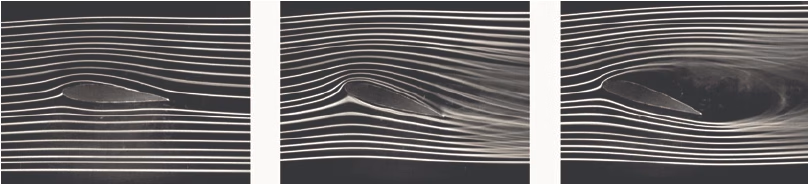
Where understanding this becomes key is in looking at air flowing over an airfoil. If Re can be considered a measure of energy, then its magnitude determines how much energy the flow has to pass by an airfoil at a given angle of attack. When Re is large enough, the air will easily flow up and over the airfoil’s leading edge, and then down its upper surface, creating the nice smooth streamlines you commonly see.
If Re is smaller and there’s less energy in the airflow, it’ll still make it over the leading edge because of the flow’s inertia. But it doesn’t have enough energy to smoothly follow the entire upper surface. At some point the airflow will break off from the surface and create a separation bubble. And if you make a large enough separation bubble, you get a stall—which effectively cuts all your lift.
What this does to an aircraft
We know our airflow’s Reynolds number impacts how well the flow stays attached. But how does this show up in the real world?
Up to a certain point, a decreasing Reynolds number won’t do much other than increase the drag of your airfoil. Quite often, there’s no substantial functional difference between a Re = 400,000 flow and a Re = 1,000,000 flow, at least where UAVs are concerned. The lift curves will overlap.
But once you start to drop below 300k, those Reynolds number effects begin to emerge. The airfoil will stall earlier—in other words, at a smaller angle of attack—because the airflow is losing the energy it needs to stay attached all the way down the upper surface. And it’ll start to have a smaller lift coefficient at each angle of attack, meaning you need a larger angle to create the same amount of lift.
So, while your aircraft is already generating less lift just from flying at a slower airspeed, you’re also decreasing the lift you can generate at each angle of attack, and your safe angle of attack range is shrinking. Like I said—transition changes the rules of the game.
To make things even more complex, most aircraft wings are not pure rectangles. They usually have some amount of taper, with the wing tip a shorter chord than the wing root. Re also depends on the length of the surface the flow interacts with; if your wing chord changes, it will experience different Reynolds numbers at different span locations. For a given airspeed, the effective Reynolds number will decrease as you move from root to tip—meaning the wingtip might get into trouble well before the rest of the airplane does.
Applying the physics to the engineering
We know the physics: as we slow down to land, the airflow over our wings is losing the energy it needs to stay attached and avoid stall.
We know the effect: at the same time we’re losing lift due to flying slower, we’re also losing lift due to the airflow itself behaving differently.
Now, how do we address it?
The quickest and cheapest way to counter how lift changes in transition is to just plain calculate it. Figure out what Reynolds number your wing and tail see in regular forward flight (which you should do anyways when picking an airfoil). But then also look at behavior for Reynolds numbers the aircraft will encounter during transition (the tool XFOIL is great for this). What happens at Re = 350k? At Re = 150k? Just knowing the speed where things start to get funky can be plenty informative.
You also need to make sure that any analysis you do evaluates the full range of behavior the wing or tail might see. Remember, Re depends on surface length: the wingtip will start to experience Reynolds number effects before the inboard portion of the wing does. This will likely increase the aircraft speed where Re effects start to matter.
Consider adding some sort of Reynolds number or airspeed-based corrections to your simulation environment. This will really depend on how your sim environment is set up and how detailed of aerodynamic models it can handle. This can look like just directly subtracting from your existing lift coefficient curve based on Reynolds number, or decreasing each value by a given percentage. I’ve helped integrate these kinds of corrections into sim environments used for autopilot tuning, and they contributed to much smoother transition phases in flights.
Is the knowledge worth the effort?
While debating these options, there’s another question that rises to the top: how much does any of this really matter? Many autopilots operate based on rates of motion: if they detect a faster descent rate than commanded—like if you’re losing lift more quickly than expected—they’ll respond by adding more upward thrust to slow that rate. If your aircraft can just boost VTOL throttle to make up for the wing’s loss of lift, does it really matter how well the aerodynamics were modeled?
Like so many things in engineering, my answer is: it depends. It depends on how much of a difference the Reynolds number effects make to your actual aero coefficients. It depends on your aircraft configuration too, and how sensitive it might be to changes in its aerodynamics and how well it can recover.
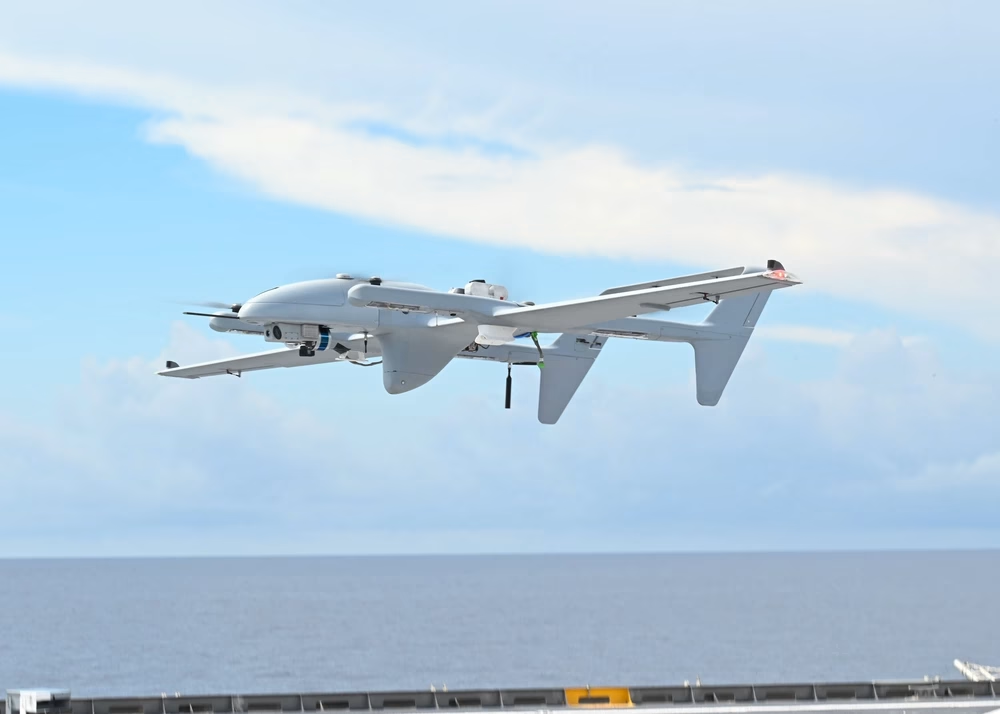
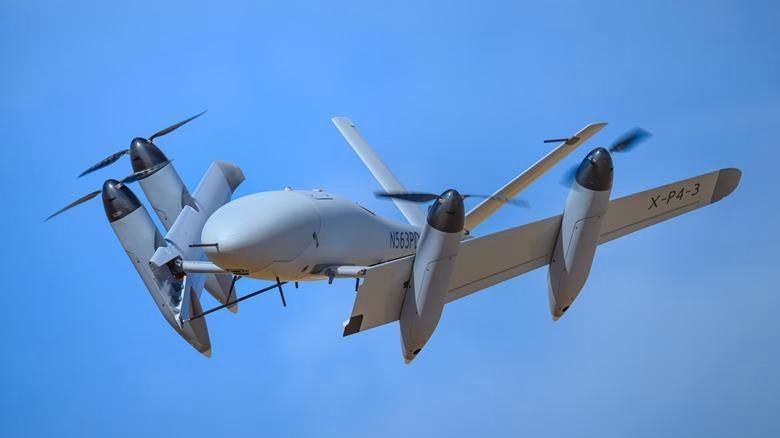
Some platforms, like the VA-120 (previously the FVR-90) have an entirely separate VTOL lift system from the forward propulsor. It can adjust VTOL thrust independently of what the wing is doing. Other aircraft, like PteroDynamics’ Transwing, have a rotation mechanism baked into their configuration. To get more lift from the props, they need to rotate them by folding the wings more, which decreases how much lift the wings generate. It’s a tricky feedback loop.
And at the end of the day, there’s the reality that we can’t spend all the time and money in the world on our analysis. The sim might not have the fidelity to integrate Reynolds number effects in a useful way. Or the program doesn’t have the budget for its aero and controls engineers to spend much time modeling those effects.
My recommendation? Take a few hours to evaluate the scope of the problem. See how gnarly your aircraft’s airfoil gets at low Reynolds numbers. Even if you can’t do anything substantial with what you find, knowing what’s going on will help to better understand your aircraft’s behavior in the most nerve-wracking 60 seconds of its flight.